
The government has adopted a multi-pronged approach involving the Army, the Indian Air Force and the Navy as well as diplomacy and economic measures to send out a firm and clear message to China that its misadventure in eastern Ladakh was not acceptable at all.

Rediff.com tells you all you need to know of some of the major ships from different countries that will participate in what is being described as 'Indian Navy's biggest event'.

Shigeru Ishiba is expected to prioritise strengthening Japan's military capabilities and fostering deeper international partnerships, particularly with India, with whom Japan shares significant strategic interests, explains Dr Rajaram Panda.

When a Chinese warship entered Japanese waters, the Indian commander called on China to maintain discipline at sea. Dr Rajaram Panda explains the significance of the Malabar exercises between India, Japan and the US.
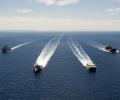
In the lead up to this week Indo-US Strategic Dialogue, for which United States Secretary of State, John Kerry, will be coming to Delhi, the Indo-US defence engagement is even more intense than usual.

The navy has significantly expanded its deployment in the Indian Ocean Region deploying a plethora of warships and submarines to create pressure points on China as the maritime space around the Malacca Strait is very critical for its supply chain through sea routes.

Indian Admirals say Malabar 2018 will involve unprecedented complexity, featuring enemy threats in all three dimensions, but especially underwater threats from submarines -- a key Chinese strength. For the first time, officers from all three navies will be posted on other navies' warships. That means Indian Navy officers will obtain the unprecedented benefits of operating on US nuclear attack submarines and Japan's highly regarded Soryu submarines.

'We use the word "historic" perhaps too much, but the prime minister's visit certainly was historic in so many ways.'
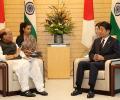
'Singh apprised the Japanese leaders about Islamabad's 'evil design' on Kashmir at a time when Pakistan has decided to internationalise the issue.'
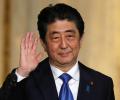
It is for the investigating agencies to probe all aspects of the assassination, including a possible Chinese hand, or if the killer was just a disgruntled element who acted on his own and wanted to earn some dark space in history like Nathuram Godse or Lee Harvey Oswald, notes Japan expert Rajaram Panda.
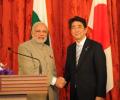
India and Japan are natural partners at sea, and Narendra Modi's recent visit underlined the need to keep the association going

The latest avatar of the F-15 is designed to deal with the world's most potent air threats that are emerging from China.

Reports (not denied by India) that the USA had 'for the first time provided real-time details to their Indian counterparts on the Chinese positions and force strength in advance of a PLA incursion' into Tawang at the LAC in December 2022, helping India thwart China's expansionist designs, show how operationally effective the USA-India friendship has become on the ground. A engaging excerpt from Sreeram Chaulia's must-read new book, Friends: India's Closest Strategic Partners.
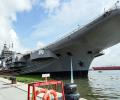
In New Delhi's corridors of power, debate continues on whether the navy even needs a third aircraft carrier.

Both have been robustly muscular leaders who began as immensely charismatic politicians conveying an impression that they were makers of history, raring to go. Both have been hyperactive on the world stage. But in the final analysis, Abe is departing on a sombre note, unceremoniously and apologetically, observes Ambassador M K Bhadrakumar.

'Assuming the official defence allocations represent the true picture, the $142 billion figure still represents a phenomenal increase and surpasses that of Japan ($42 billion), India ($40 billion), South Korea ($33 billion) and several other Asian countries put together and shows that China is flexing its military muscle.'

Military sources said the research ship Shi Yan 1 forayed into Indian waters in September but was forced to retreat after it was suspected to be involved in spying.
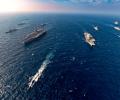
China's behaviour in the post-pandemic geopolitical landscape which may determine the Quad's future trajectory, notes former foreign secretary Shyam Saran.
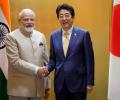
With the signing of the pact, the Quad grouping of India, Japan, Australia and the US is set to gain more heft now, notes Dr Rajaram Panda.
'Since each chief single-mindedly pursues his service's interests in the competition for turf and in core matters such as budget share. The CDS, therefore, must act as an "honest broker" whose decisions serve the broader national purpose, rather than narrow service interests,' says Ajai Shukla.

China's South China Sea build-up and 'territorial sea' construct potentially affects 55 percent of Indian trade passing through the region. Hence, coordinating with the US and Japan could provide dividends to India in the longer run,' says Srikanth Kondapalli.

Although the pact would focus mainly on the Pacific and the South China Sea region, any action designed to deter China with or without New Delhi's active participation is a welcome move, notes Commodore Venugopal Menon (retd).

The known unknowns in Prime Minister Modi's Saudi visit assume great significance, says Ambassador M K Bhadrakumar.

Taiwan says it detected multiple Chinese aircraft and naval vessels taking part in military drills around the Taiwan Strait on Saturday, in what could be a possible simulated attack against the island.
The statement of Commander of US Indo-Pacific Command Admiral John Aquilino on Wednesday came ahead of the 15th round of high-level military talks between India and China on March 11.

India cannot choose its geography and devise regional strategies to dovetail into the Western Indian Ocean hypothesis conceived in the Pentagon, argues Ambassador M K Bhadrakumar.

The agreement would divert China's attention and keep them busy in the Pacific theatre, probably resulting in a reduction in threat perception in our area of interest in the Indian Ocean, notes Commodore Venugopal Menon (retd).

Excerpts from Prime Minister Narendra Modi's speech at the Combined Commanders Conference on board the INS Vikramaditya at sea, off the coast of Kochi.
China released a white paper against the UN-backed tribunal's verdict, insisting that Beijing has claims over the strategic region for 2,000 years.

Rajaram Panda explains why the US president needs to restrain himself and build a relationship with China to put any credible pressure on North Korea.
As India's international role expands, so must our capabilities, says Brigadier Gurmeet Kanwal (retd).

One of the most sought after exhibitions in Asia, as many as 549 companies are participating this year with 53 fighter aircraft on display.

The Americans have expended a lot of diplomatic energy to coax India into toeing their line but India has refused to buckle under pressure. As Foreign Minister Subrahmanyam Jaishankar said, India has not taken anyone's side but its own side, points out Virendra Kapoor.

'The military aim in a future conflict, if it can't be avoided, should be to cause maximum damage to the adversary's war waging capability and capture limited amount of territory as a bargaining counter,' says Brigadier Gurmeet Kanwal (retd).

As the pandemic unfolded, the India-China relationship has come under severe stress. To restore normalcy, agreements between the two countries must be respected scrupulously in their entirety. Where the Line of Actual Control is concerned, any attempt to unilaterally change the status quo is unacceptable, declares External Affairs Minister Dr Subrahmanyam Jaishankar.

'During his visit to Vietnam on September 3 -- the first visit by an Indian prime minister in 15 years -- Modi will notice the widespread anti-China sentiment in that country.'

From early indications, the Modi government's foreign policy seems to be pragmatic and reciprocal, says K G Suresh.

Just like China wants Trump to lose the US presidential poll, it may want Modi to lose the Lok Sabha polls. So months before the 2024 elections, China may take possession of an important area, say one of the Char Dhams, warns Sanjeev Nayyar.

The two countries also signed three other agreements -- to enhance aviation links, to jointly work in the area of energy efficiency and promotion of parliamentary cooperation.

President Pranab Mukherjee on Monday addressed the first joint sitting of Parliament as mandatorily required under the Constitution after the general elections. The address is the political, economic and foreign policy road map of the Narendra Modi government and covers virtually all crucial areas.
